
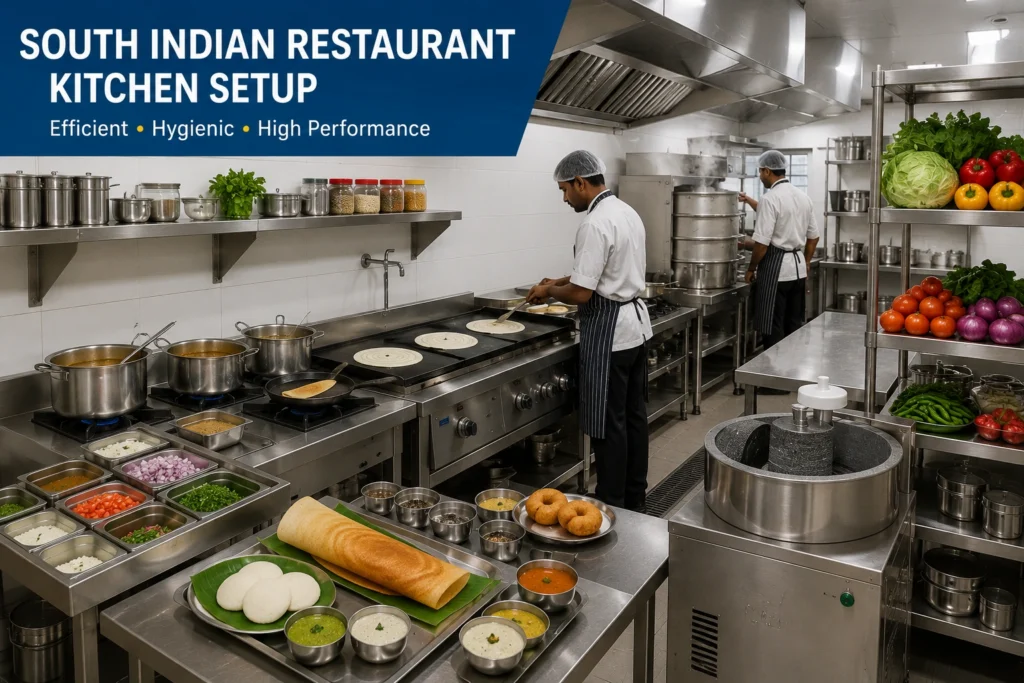
A successful South Indian Restaurant Kitchen Setup requires more than simply purchasing cooking equipment and arranging it inside a kitchen. South Indian cuisine involves specialized preparation methods, high-volume cooking, steaming, grinding, frying, roasting, and fast service. Therefore, the kitchen needs to be planned around workflow, hygiene, equipment capacity, storage, ventilation, and the restaurant’s expected daily volume. With the right planning, Balaji Kitchen can help businesses create a practical commercial kitchen environment designed for efficient South Indian food preparation.
Whether you are opening a dosa restaurant, vegetarian restaurant, South Indian café, cloud kitchen, food court outlet, or a large dining establishment, your kitchen layout can directly influence speed, consistency, cleanliness, and operating costs.
Understanding a South Indian Restaurant Kitchen Setup
South Indian cuisine has unique cooking requirements that make kitchen planning particularly important. Popular dishes such as dosa, idli, vada, sambar, chutneys, pongal, rice dishes, and various curries require different preparation techniques.
For example, dosa production requires batter storage and preparation, controlled cooking surfaces, oil application, and fast serving. Idli production requires suitable steaming equipment, while chutneys and batter may require commercial grinding equipment.
A well-planned South Indian Restaurant Kitchen Setup connects these activities logically. Raw ingredients should move efficiently toward preparation areas, cooking stations, plating, and service without creating unnecessary cross-traffic.
The objective is to create a kitchen where chefs and kitchen staff can work comfortably while maintaining consistent food quality and hygiene.
Essential Equipment for a South Indian Kitchen
Cooking Equipment
Cooking equipment forms the core of any commercial South Indian kitchen. Depending on the menu, a restaurant may require commercial gas ranges, heavy-duty burners, dosa plates, tilting wet grinders, cooking ranges, deep fryers, rice preparation equipment, and specialized cooking stations.
The dosa counter deserves particular attention because dosa is often prepared continuously during busy service periods. A suitable dosa plate should provide consistent heating across the cooking surface and offer enough working space for the kitchen team.
For restaurants serving multiple varieties of dosa, the cooking station should also have adequate space for batter, oil, toppings, utensils, and finished orders.
Idli and Steaming Equipment
Steaming is another important part of South Indian food preparation. Restaurants serving idli, dhokla-style steamed items, or other steamed foods need appropriate commercial steamers or idli cooking systems.
The capacity should match expected production volume. A small restaurant may not need a large industrial steaming system, while a high-volume establishment may require equipment capable of handling multiple batches during peak hours.
Proper placement is also important. Steam-producing equipment should be positioned where ventilation and drainage can be managed effectively.
Commercial Wet Grinders
A commercial wet grinder is one of the most important pieces of equipment in many South Indian kitchens. It can be used for preparing dosa and idli batter and other food preparations requiring grinding.
Choosing the right grinder depends on the quantity of batter needed, operating hours, kitchen space, and production schedule. A restaurant serving hundreds of portions each day may require a considerably larger capacity than a small café.
The grinder should also be positioned conveniently near ingredient preparation and batter storage areas to reduce unnecessary movement.
Refrigeration and Storage
Ingredient storage is another major consideration. Commercial refrigerators, freezers, storage racks, ingredient bins, and work tables help organize the kitchen and protect food quality.
South Indian restaurants may need to store vegetables, dairy products, batter ingredients, coconut, spices, prepared foods, sauces, and other perishable materials. Refrigeration capacity should therefore be planned according to the menu and purchasing cycle.
Dry storage should remain organized and protected from moisture and contamination. Stainless steel racks can provide a practical solution for commercial kitchens because they are durable and relatively easy to clean.
Designing an Efficient South Indian Restaurant Kitchen Setup
A professional South Indian Restaurant Kitchen Setup should follow a logical workflow. Ideally, ingredients should move from receiving and storage to preparation, cooking, plating, and service with minimal backtracking.
The preparation area should provide sufficient working surfaces for cleaning, cutting, mixing, grinding, and ingredient handling. It should also be positioned close enough to cooking stations to maintain an efficient workflow.
The cooking area should accommodate the restaurant’s major equipment without becoming overcrowded. Dosa plates, burners, fryers, steamers, and other cooking systems should have sufficient operating space around them.
Service and plating areas should be positioned strategically so completed dishes can reach servers quickly. In a busy restaurant, even a small delay can become significant when repeated hundreds of times throughout the day.
Ergonomics also matters. Equipment that staff use frequently should be positioned at convenient working heights and locations. This can reduce unnecessary movement and make the kitchen easier to operate during peak service.
Choosing the Right Equipment and Capacity
Selecting commercial kitchen equipment based solely on price can create problems later. The equipment must match the restaurant’s menu, daily production, available space, workforce, and expected customer volume.
For example, a small South Indian café may require a compact cooking line, moderate-capacity grinder, smaller refrigeration system, and limited storage. A large restaurant may need multiple dosa stations, high-capacity steamers, larger grinders, multiple burners, extensive refrigeration, and dedicated preparation areas.
Energy consumption should also be considered. Equipment that operates for many hours every day can significantly affect operating costs. Businesses should therefore consider efficiency, durability, maintenance requirements, and expected operating life when making purchasing decisions.
Stainless steel construction is widely preferred for commercial kitchen environments because it provides durability and supports hygienic cleaning practices. However, the specifications should still match the intended application and operating conditions.
Balaji Kitchen can help businesses evaluate their kitchen requirements and select equipment according to their operational needs rather than using a one-size-fits-all approach.
Hygiene and Ventilation Considerations
Hygiene should remain a central part of every South Indian Restaurant Kitchen Setup. Commercial kitchens handle raw ingredients, cooked foods, oils, spices, batter, and moisture throughout the day. Without proper cleaning and organization, these conditions can create sanitation challenges.
Work surfaces should be easy to clean, and equipment should be arranged so staff can access areas that require regular maintenance. Floors should support effective cleaning and drainage, while waste disposal should be organized to prevent contamination.
Ventilation is equally important. Cooking generates heat, smoke, steam, and odors. A suitable commercial exhaust system can help remove unwanted heat and cooking fumes from the kitchen environment.
The exhaust and fresh-air requirements should be considered during the kitchen design stage rather than added as an afterthought. Proper ventilation can make the kitchen more comfortable for staff and support a cleaner working environment.
Why Balaji Kitchen Can Be Your Kitchen Partner
A commercial kitchen is a long-term investment, so businesses benefit from working with a kitchen equipment partner that understands practical restaurant requirements. Balaji Kitchen focuses on solutions for commercial food-service environments and can assist businesses in planning their kitchen around menu requirements, available space, and expected production.
The right approach begins with understanding the restaurant rather than simply recommending equipment. Kitchen dimensions, menu design, cooking volume, workflow, storage needs, staff movement, and service style all influence the final configuration.
Balaji Kitchen can help businesses consider these factors while developing a professional kitchen setup. The goal is to create a functional environment where equipment supports the cooking process instead of becoming an obstacle.
For new restaurants, proper planning can also reduce the risk of purchasing unnecessary equipment or discovering that essential equipment does not fit comfortably within the available space.
Common Kitchen Setup Mistakes to Avoid
One common mistake is overcrowding the kitchen with too much equipment. More equipment does not automatically mean better productivity. If staff cannot move comfortably between workstations, production can become slower.
Another mistake is ignoring future growth. A restaurant may begin with moderate demand but experience higher volumes after building a strong customer base. Where practical, the kitchen should allow some flexibility for additional equipment or production capacity.
Poor ventilation planning is another issue that can affect daily operations. Heat and smoke can make working conditions uncomfortable and may also affect the cleanliness of surrounding areas.
Businesses should also avoid compromising on storage. Without adequate storage, ingredients and utensils may occupy preparation surfaces, reducing available workspace and making the kitchen harder to maintain.
Finally, equipment maintenance should be considered from the beginning. Regular cleaning, inspection, servicing, and proper operation can extend equipment life and support consistent kitchen performance.
Frequently Asked Questions
What is a South Indian Restaurant Kitchen Setup?
A South Indian Restaurant Kitchen Setup is a professionally planned commercial kitchen designed specifically around the preparation and service requirements of South Indian cuisine. It can include dosa plates, wet grinders, idli steamers, cooking ranges, fryers, refrigeration, preparation tables, storage systems, exhaust equipment, and other essential kitchen solutions.
What equipment is needed for a South Indian Restaurant Kitchen Setup?
The equipment depends on the restaurant’s menu and production volume. Common requirements include commercial burners, dosa plates, wet grinders, idli steamers, fryers, refrigerators, preparation tables, storage racks, exhaust systems, and food-service equipment.
How do I plan a South Indian Restaurant Kitchen Setup for a small restaurant?
A small restaurant should prioritize essential equipment and an efficient workflow. The layout should provide dedicated areas for preparation, cooking, storage, washing, and service without overcrowding the available space. Equipment capacity should match the expected daily customer volume.
Why is a commercial wet grinder important in a South Indian kitchen?
A commercial wet grinder is useful for preparing dosa and idli batter and other grinding-based preparations. Its capacity should be selected according to the quantity of batter required and the restaurant’s daily production schedule.
How important is ventilation in a South Indian restaurant kitchen?
Ventilation is extremely important because commercial cooking produces heat, steam, smoke, and food odors. A properly planned exhaust and ventilation system can improve working conditions and help maintain a cleaner kitchen environment.
Can Balaji Kitchen help with a complete restaurant kitchen setup?
Balaji Kitchen can assist businesses with commercial kitchen planning and equipment requirements based on factors such as menu, available space, expected production, and workflow. The exact equipment configuration should be finalized according to the individual restaurant’s operational needs.
Conclusion
A professionally planned South Indian Restaurant Kitchen Setup can provide the foundation for efficient food preparation, consistent cooking, smooth service, and better kitchen management. From dosa plates and wet grinders to idli steamers, refrigeration, storage, cooking equipment, and ventilation systems, every element should work together as part of a practical workflow.
The ideal setup depends on the restaurant’s menu, kitchen dimensions, customer volume, staffing, and future growth plans. Choosing equipment based on these factors can help businesses avoid unnecessary expenses while creating a comfortable and productive working environment.
For restaurants planning a new kitchen or upgrading an existing facility, Balaji Kitchen can provide professional guidance and commercial kitchen solutions tailored to operational requirements. Contact Balaji Kitchen today to discuss your South Indian Restaurant Kitchen Setup and plan a professional kitchen designed for efficient, high-volume food service.