
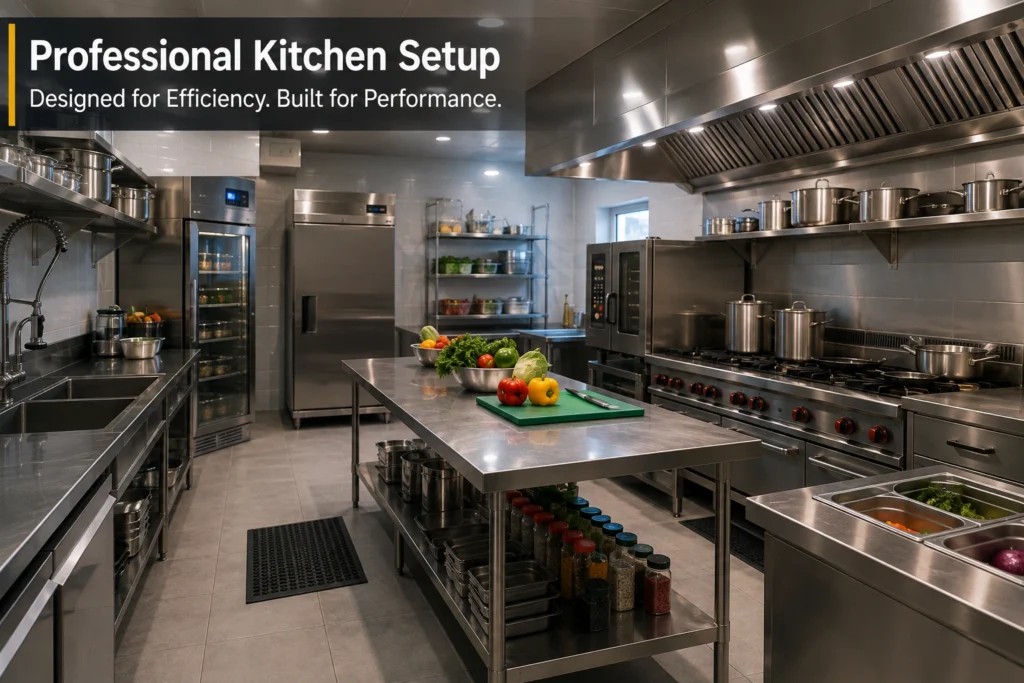
A successful food business needs more than a great menu and skilled chefs. The kitchen must be planned around efficiency, hygiene, safety, storage, staff movement, and consistent food production. This is why choosing the right professional kitchen setup in Delhi is an important decision for restaurants, hotels, cafés, cloud kitchens, canteens, bakeries, hospitals, and institutional food-service facilities. A well-designed kitchen can improve workflow while making better use of available space and equipment.
Delhi has a highly competitive food-service market, with restaurants and commercial food businesses operating across residential, corporate, hospitality, and institutional locations. In such an environment, an efficient professional kitchen setup can support smoother operations and help businesses manage daily production requirements. Balaji Kitchen provides commercial kitchen planning and equipment solutions for businesses looking to develop functional and practical food-service environments.
Why a Professional Kitchen Setup Matters
The kitchen is the operational center of any food-service business. Every stage, from receiving ingredients to preparation, cooking, plating, cleaning, and storage, depends on how the space is organized.
A poorly planned kitchen can create unnecessary movement, congestion, storage problems, equipment conflicts, and workflow delays. In contrast, a properly planned kitchen allows employees to move logically between workstations and complete tasks more efficiently.
A professional setup also considers the relationship between different kitchen areas. Preparation should be positioned logically in relation to cooking, while washing and waste-handling areas should be planned to support hygiene and operational efficiency.
Therefore, businesses should treat kitchen planning as an investment in their overall operation rather than simply purchasing individual pieces of equipment.
7 Powerful Benefits of a Professional Kitchen Setup
1. Better Kitchen Workflow
One of the biggest advantages of a professional kitchen setup in Delhi is improved workflow. Commercial kitchens handle multiple activities simultaneously, so equipment and workstations must be positioned carefully.
For example, vegetables and other ingredients may need to move from storage to preparation, then to cooking and finally to serving. If these areas are poorly positioned, employees may need to repeatedly cross the same space.
A well-planned layout reduces unnecessary movement and creates a more logical sequence of operations. This can help kitchen staff work more comfortably and maintain better coordination during busy service periods.
2. Efficient Use of Available Space
Commercial kitchen space is often limited, particularly in restaurants, cafés, cloud kitchens, and urban food outlets. Every square foot needs to contribute to the operation.
A professional kitchen designer considers the dimensions of the room, entry points, ventilation requirements, equipment sizes, storage needs, staff movement, and workflow before finalizing the layout.
Depending on the site, businesses may consider straight-line, L-shaped, U-shaped, island, or other suitable commercial kitchen configurations. The best layout depends on the menu, production volume, available area, and operational requirements.
An efficient professional kitchen setup makes it possible to use the available space without creating unnecessary congestion.
3. Improved Hygiene and Organization
Food hygiene is fundamental to every commercial kitchen. The design should support clean working practices and make it easier for staff to separate different activities.
Stainless steel worktables, suitable sinks, storage systems, preparation counters, and appropriate equipment placement can contribute to an organized working environment. Surfaces should also be easy to clean and maintain.
A properly planned kitchen can help establish clearer zones for food preparation, cooking, washing, storage, and waste management. Businesses should also follow applicable food-safety regulations and hygiene procedures in addition to investing in suitable equipment.
4. Greater Operational Productivity
Productivity depends on how effectively people, equipment, ingredients, and space work together. When employees can access the right equipment without unnecessary movement, daily operations can become smoother.
For instance, placing frequently used cooking equipment near the relevant preparation and service areas can reduce workflow interruptions. Similarly, adequate storage near preparation stations can make ingredient handling more convenient.
A professional kitchen setup in Delhi should therefore be designed around the actual menu and production process. A kitchen serving fast food will have different requirements from a hotel banquet kitchen or a South Indian restaurant.
5. Appropriate Equipment Selection
Commercial kitchens require equipment that matches their workload. Buying too little equipment can create operational bottlenecks, while purchasing excessive equipment can consume valuable space and increase costs.
Depending on the business, equipment may include cooking ranges, burners, ovens, fryers, refrigeration units, worktables, preparation equipment, exhaust systems, sinks, dishwashing solutions, storage racks, and service counters.
Equipment specifications should be evaluated according to capacity, dimensions, energy requirements, expected usage, maintenance, and compatibility with the planned kitchen layout.
This is one reason businesses should plan the complete kitchen before purchasing equipment individually.
6. Better Safety and Staff Movement
Kitchen environments involve heat, electricity, gas, sharp tools, liquids, and heavy equipment. Therefore, safety should be considered during the design stage.
A suitable layout should provide enough working space for employees to move between stations without unnecessary obstruction. Hot equipment should be positioned appropriately, while ventilation and exhaust requirements should be addressed according to the kitchen’s operational needs.
Flooring, drainage, lighting, equipment positioning, and access to cleaning areas can also influence the working environment.
A professional approach to kitchen planning helps businesses consider these factors before installation rather than trying to correct layout problems after the kitchen becomes operational.
7. Long-Term Business Value
A commercial kitchen represents a significant investment. A well-planned setup can provide value beyond its initial installation because it supports everyday operations for years.
Good planning can also make future changes easier. As a business grows, it may need additional equipment, storage, preparation capacity, or service stations. A flexible layout can make future modifications more practical.
Instead of focusing only on the lowest initial price, businesses should consider equipment quality, functionality, maintenance, workflow, installation, and expected operating requirements.
Professional Kitchen Setup in Delhi for Different Businesses
Different food-service businesses require different kitchen solutions. Restaurants may need a combination of cooking, preparation, refrigeration, storage, washing, and service equipment based on their menu and expected customer volume.
Hotels often require larger and more specialized kitchens because they may support restaurants, room service, banquets, events, and other food-service operations. Their kitchens may need multiple preparation and cooking sections.
Cloud kitchens usually prioritize compact layouts, efficient order handling, storage, and delivery-focused production. Because there is no traditional dining area, the kitchen layout can be designed around production and dispatch.
Institutional kitchens, such as those used in corporate canteens, hospitals, schools, and large facilities, may have high-volume food production requirements. These environments need careful planning around bulk preparation, cooking, storage, washing, and distribution.
Bakeries and cafés have their own equipment requirements, often involving ovens, mixers, refrigeration, preparation tables, display areas, and specialized storage.
This variety demonstrates why a professional kitchen setup in Delhi should be customized according to the business rather than copied from another facility.
How to Plan a Commercial Kitchen
The planning process should begin with the business concept. Identify the cuisine, menu, expected production volume, number of employees, operating hours, and service style.
The menu is particularly important because it determines much of the required equipment. A bakery, for example, will have different equipment requirements from a commercial Indian restaurant.
Next, evaluate the available space. Measure the kitchen area and identify doors, windows, columns, drainage points, electrical connections, gas requirements, ventilation routes, and other site conditions.
After that, establish functional zones. These may include receiving and storage, preparation, cooking, plating or service, washing, and waste-handling areas. The exact configuration should depend on the specific operation.
Equipment can then be selected according to capacity and available space. Each item should have enough surrounding clearance for operation, cleaning, and maintenance.
Finally, review the complete layout before installation. This is an important stage because changes are generally easier to make on paper than after equipment has been installed.
Choosing the Right Commercial Kitchen Equipment
Selecting commercial kitchen equipment requires a balance between performance, capacity, space, maintenance, and budget. Businesses should avoid purchasing equipment simply because it appears attractive or has a large capacity.
Start with the menu and production requirements. Determine which cooking methods are used most frequently and how much food the kitchen needs to produce during peak periods.
Material quality also matters. Stainless steel is widely used in commercial kitchen environments because it is practical for many work surfaces and equipment applications. However, the exact material specification should be selected according to the product and intended use.
Energy consumption and utility requirements should also be considered. Gas, electrical, water, drainage, and exhaust requirements need to be incorporated into the kitchen design.
Maintenance should not be overlooked. Equipment should be accessible enough for routine cleaning, inspection, and servicing. Reliable supplier support can also be valuable when managing a commercial kitchen over the long term.
Why Choose Balaji Kitchen?
Balaji Kitchen provides commercial kitchen solutions for businesses that need practical equipment and organized kitchen planning. For companies searching for a professional kitchen setup in Delhi, choosing an experienced kitchen solution provider can simplify the process from layout planning through equipment selection and installation.
The requirements of every kitchen are different. Balaji Kitchen can help businesses consider their available space, menu, production volume, workflow, storage needs, and equipment requirements when developing a suitable setup.
Whether the project involves a restaurant, hotel, café, bakery, cloud kitchen, industrial canteen, institutional kitchen, or another food-service facility, the objective should be to create a kitchen that supports efficient daily operations.
Businesses should clearly communicate their requirements before beginning the project. Information about the menu, expected capacity, available space, budget, utility connections, and operational process can help create a more appropriate kitchen plan.
A professional kitchen is not simply a collection of machines. It is a coordinated system in which layout, equipment, staff movement, storage, hygiene, ventilation, and workflow work together.
Frequently Asked Questions
1. What is a professional kitchen setup in Delhi?
A professional kitchen setup in Delhi is a planned commercial food-service environment designed around cooking, preparation, storage, washing, ventilation, hygiene, staff movement, and service requirements. It can be developed for restaurants, hotels, cafés, cloud kitchens, canteens, bakeries, hospitals, and other institutional food facilities.
2. Why should I invest in a professional kitchen setup?
A professional kitchen setup can improve workflow, make better use of available space, support organized food preparation, and provide suitable equipment for daily operations. Proper planning can also help businesses reduce unnecessary movement and create a more practical working environment.
3. What equipment is required for a commercial kitchen?
The equipment depends on the menu, production volume, kitchen size, and type of business. Common requirements may include cooking equipment, refrigeration, preparation tables, sinks, storage racks, ventilation systems, ovens, fryers, and other specialized equipment. A kitchen plan should determine the exact equipment requirements.
4. How do I choose the right commercial kitchen layout?
The right layout depends on the kitchen’s size, menu, staff workflow, equipment requirements, service style, and expected production volume. L-shaped, U-shaped, straight-line, island, and other configurations may be appropriate for different operations. The layout should prioritize logical movement and efficient use of space.
5. Is a professional kitchen setup suitable for a cloud kitchen?
Yes. A professional kitchen setup in Delhi can be designed specifically for cloud kitchens. Since cloud kitchens focus primarily on food preparation and delivery, the layout can prioritize production efficiency, order coordination, ingredient storage, cooking stations, packing, and dispatch.
6. How much does a professional kitchen setup cost?
The cost varies significantly depending on kitchen size, equipment selection, material specifications, layout, ventilation, refrigeration, cooking capacity, storage, installation, and customization. Businesses should obtain a project-specific estimate after assessing the site and operational requirements.
7. Why is kitchen layout important for restaurant operations?
Kitchen layout directly affects staff movement, equipment accessibility, preparation time, storage, cleaning, and coordination between different workstations. A practical layout can reduce unnecessary movement and help employees work more efficiently, especially during busy service periods.
Conclusion
A well-designed commercial kitchen can become one of the strongest foundations of a successful food-service business. From efficient workflow and space utilization to hygiene, safety, equipment selection, and long-term operational value, every element deserves careful planning.
A professional kitchen setup in Delhi should be designed around the business’s menu, production capacity, available space, staff movement, equipment requirements, and future needs. Businesses should avoid choosing equipment independently without considering how every component will work together within the complete kitchen.
Balaji Kitchen can assist businesses looking for practical commercial kitchen solutions tailored to their operational requirements. Whether you are opening a restaurant, expanding a hotel kitchen, developing a cloud kitchen, setting up a canteen, or planning an institutional food facility, professional planning can make the process more efficient.
If you are planning a professional kitchen setup in Delhi, contact Balaji Kitchen today to discuss your space, menu, equipment requirements, and commercial kitchen project.